By Scott Nossen
Technology for technology’s sake can be problematic. As a future English Language Arts teacher, the idea of doing something “because you can,” brings to mind Mary Shelley’s Frankenstein. Certainly, making a person from corpse parts is impressive, but what is the benefit? Nothing, and at great cost. Similarly, creating a lesson plan around a new iPad simply because it is there might draw “oohhs” and “aahhs,” but if the device is no more than a sleek distraction, what was gained? If the lesson plan is sound and the iPad functions to reinforce pedagogy and make content standards achievable, then the technology has justified its use. Using the iPad to transition between scenes in an ebook version of Frankenstein and the corresponding scenes from the 1931 film adaptation, for example, would be an efficient and engaging way to get students to compare and contrast a novel they have studied with a filmed adaptation (NCSCS.ELA.RL.7.7), all the while keeping the focus on the content. Teaching with technology works most effectively when the technology melts into the background.
I believe in utilizing technology only when it supports and enhances content because I will be teaching an English Language Arts Class and teaching technology exclusively (or using content to prop up technology) is something else entirely; it is no longer ELA. In essence, I believe technology should function as a facilitator. As Koehler, Mishra and Cain (2013) argue, “What is needed is an approach that treats teaching as an interaction between what teachers know and how they apply this knowledge in the unique circumstances or contexts within their classrooms” (p.14). What the authors are getting at is that, when teaching with technology at the highest level, the technology can bridge whatever chasm exists between content knowledge and pedagogical knowledge. There is the matter and there are the methods and–at best–technology is the means by which I can bring them together. As a classroom example, consider a unit on Lord of the Flies. One way I would consider implementing technology is via the creation of an online message board with only the bare minimum of oversight or rules, through which students can communicate and work on a final project. Here, I utilize TPACK (Technological Pedagogical Content Knowledge) is the technology props up the pedagogy, and the pedagogy props up the content knowledge (because this is an English class, after all). In essence, the online message board (the technology), allows students to work in groups (a preference of young adolescent learners, and a demonstration of pedagogy), while the relative lack of rules and the vague freedom of online discourse provides a sense of “chaos” (demonstrating an important theme in Lord of The Flies, and an application of content knowledge). Still, while it is important to use technology in the right ways, it is just as important to use the right technology.
As an ELA teacher, I believe technology works best when it contains a narrative component because divorcing ELA learning from the written word removes the backbone of both the discipline and most state mandated standards. Not all technology is equal in all areas; not all technology works with the content taught. Finding a particular sub-set of digital competencies that speaks to and promotes my required teaching is paramount. For example, under the Digital Communication competencies promoted by Bryn Mawr College (2019), “Becoming familiar with and comfortable using a range of digital publishing or social media tools, such as blogs, wikis, WordPress, Twitter, etc.” is an excellent starting-off point for teaching to NCSCS.ELA-Writing.W.7.4 Use digital tools and resources to produce and publish writing, link to and cite sources, and to interact and collaborate with others. This digital competency (and this application of technology) is relevant because, and only because, the act of writing is baked in. While other digital competencies might be important in a broad sense (for example, “Developing and practicing strategies for protecting your own data and data entrusted to you against theft, misappropriation, or loss” (Bryn Mawr College, 2019)), they would only be relevant to an ELA classroom if shoehorned-in. In short, without any reading or writing component, I would not consider a technological application appropriate for my ELA classroom. And even then, it is important to place focus on how these technologies are implemented into the classroom.
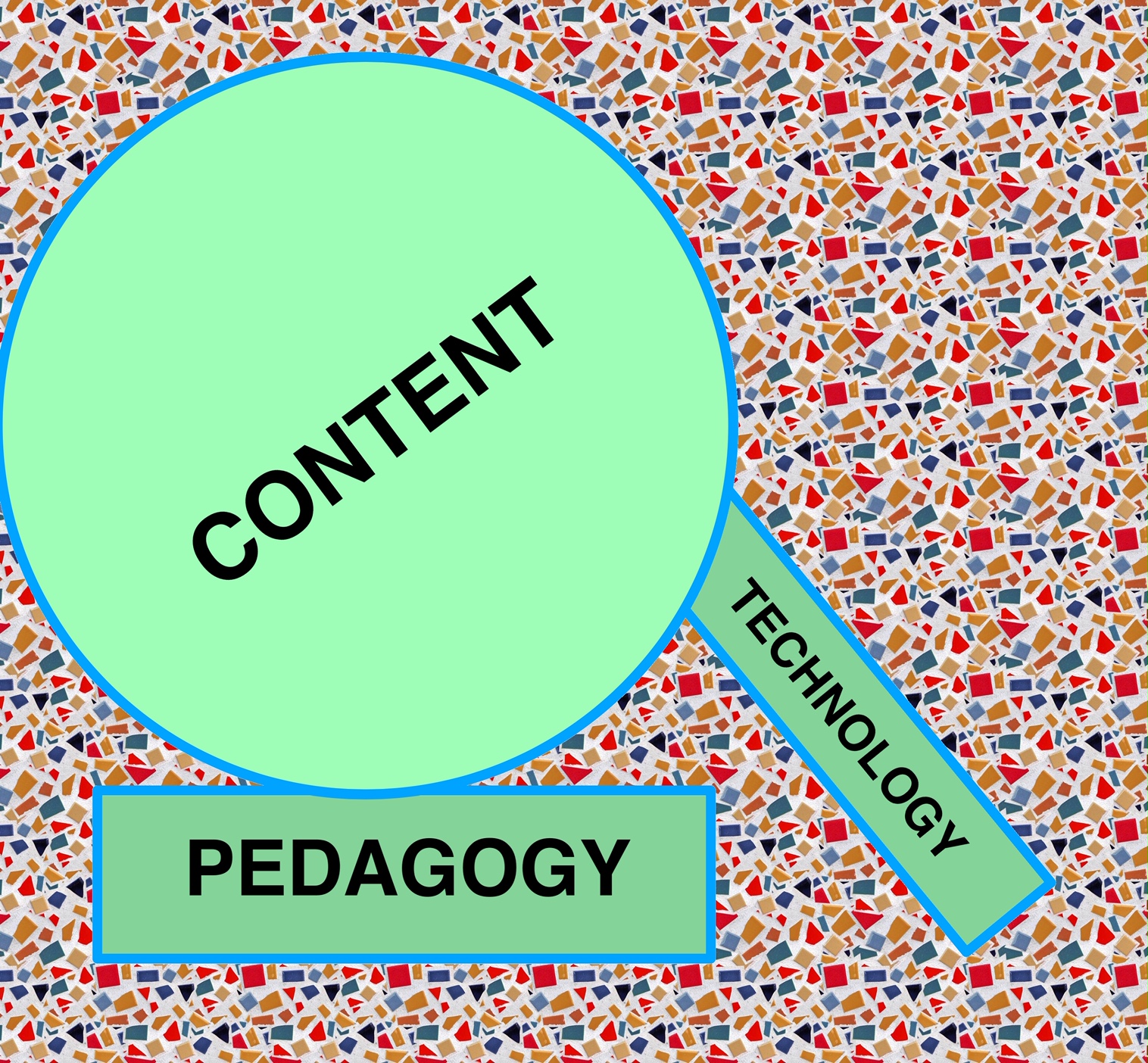
Image 1 illustrates the ideal role technology plays in my vision of teaching. Content is the main focus, the largest part of the equation. Content is held up by pedagogy and if nothing else were added, the two could stand alone. Together, they comprise the necessary ingredients of a lesson. Technology is in the background and not visible if one looks at content head-on. It provides a support. It is not necessary, but, used wisely, it makes the entire endeavor more stable.
I believe in introducing all technologies at the novice level because, due to diverse backgrounds, it is unfair to assume student familiarity. It is easy to take for granted that, just because students were born after the year 2000–just because they have only know a world with ubiquitous computers and internet literally floating in the air around them at all times–that they themselves have had access to this ever present technology. As Erika Smith (2012) explains when referencing Hargittai (2010), “…socio-economic status, including race and gender, [are] a significant factor and an important predictor of technology skills, abilities, and habits” (p. 9). Not every student has a smartphone, not every student grows up with a household computer. Further, even students who do have access might be loath to use such technology (perhaps they do not find applications are aimed at their interests, perhaps they simply prefer climbing trees). There are a few strategies I plan to implement to account for this possible, even likely discrepancy in technical savvy. First, all my assignments that involve technology will be be classroom-only (i.e. no homework). This prevents an unfair advantage for students that a) have access to technology at home or, b) have access to more advanced applications at home. Second, all technology I teach, will be taught as though students have no prior knowledge, beginning with a tutorial on usage and extending to after-class availability on my part for students who may struggle with even the most basic application. Whatever the solution, I understand that students may not fully grasp the technological applications used in class, and simply going full-steam-ahead with their use only serves to widen the knowledge (and resource…and achievement) gap. On the whole, promoting any sort of disparity is neither sound pedagogy, nor particularly empathic. And while working from a base level of technological knowledge is a strong approach to empathic teaching, there are ways to take it further.
I believe the implementation of technology in education should be arrived at democratically because the collaboration reinforces empathy and gives students a stake in the learning process. One of the drawbacks Rebekah Willett (2017) found in her study was that students, “weren’t working hard enough, they weren’t committed to the projects and they didn’t spend time practicing using the software…the boys would have learned if they had shown more interest” (p. 139). If a technology or the application of a particular technology does not move my students, then the results can be counterproductive. Any ease or advancement is nullified if students find themselves bored (and, depending on the content, literature can be boring enough for young adolescents). Including students in the application of technology (or at the very least gauging their interest) is key to any project’s success. Using my previous example of a class internet discussion board, if some students find it an easy way to anonymously blend into the background and avoid participation, then despite its merits and good intentions, it is not a practical application of the technology. As Devorah Heitner (2014) posited, “If we want to raise kids who are thoughtful and use digital technology for good things, we have to get curious about what it’s like to be a ten year old with a smart phone.” In other words, I need to think, “Will this be something my students enjoy? Will participation in this activity excite my students?” In the end, the technology is not for me, it is for them. To consider their needs is important, but so too is consideration of their enthusiasm.
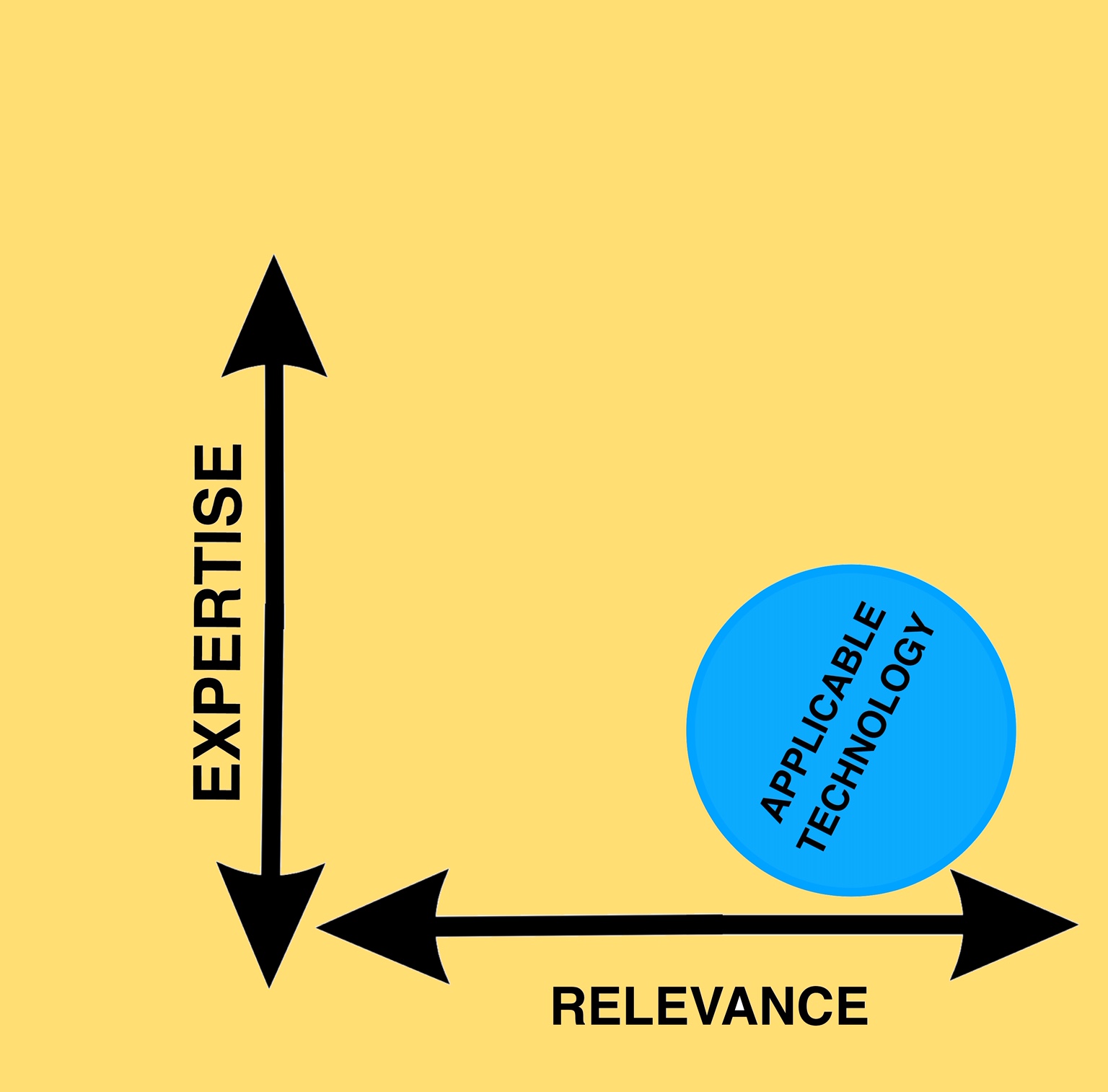
Image two illustrates my ideal application of technology. On the y-axis, representing a spectrum of experience levels, I believe technology is most effectively implemented in the classroom when taught at the novice level. On the x-axis, representing a spectrum of relevance, I believe technology is most effective when it is most relevant to the content area and the students as learners. Therefore, I believe the ideal application of technology is that which provides the most relevance while requiring the lowest-level of necessary expertise.
Technology is not a reason in and of itself. When I utilize it in such a way that it pushes content to the forefront of the lesson, technology is in the sweet-spot. Further, when I choose technology that has applications of the subject area baked in, it becomes immediately applicable and relevant. And when I apply technology, it is implemented at the most basic levels, ensuring it doesn’t “overpower” my students (to say nothing of the content). Finally, I support arriving at technological applications along with my students; if it does not work for them, it simply does not work. When teaching with technology, I aim to support not outshine.
References:
Bryn Mawr College. (2019). Digital Competencies. Retrieved from https://www.brynmawr.edu/digitalcompetencies
Heitner, Devorah. (2014). The challenges of raising a digital native [Video file].Retrieved from https://www.youtube.com/watch?v=eRQdAOrqvGg
Koheler, M.J., Mishra, P., & Cain, W. (2013). What is Technological Pedagogical Content Knowledge (TPACK)? Journal of Education, 193:3, 13-19. doi: 10.1177/002205741319300303
North Carolina Standard Course of Study. English Language Arts Standards. Reading: Literature. Grade 7. NCSCS.ELA RL.7.7
North Carolina Standard Course of Study. English Language Arts Standards. Writing. Grade 7. NCSCS.ELA W.7.4
Smith, E. (2012). The Digital Native Debate in Higher Education: A Comparative Analysis of Recent Literature / Le débat sur les natifs du numérique dans lenseignement supérieur: Une analyse comparative de la littérature récente. Canadian Journal of Learning and Technology / La Revue Canadienne De L’apprentissage Et De La Technologie, 38(3). doi:10.21432/t2f302
Willett, R. (2005). New Models of Learning for New Media: Observations of Young People Learning Digital Design. Jahrbuch Medien-Pädagogik 4, 127-144. doi:10.1007/978-3-322-90687-8_8
Images:
Nossen, Scott. (2019). Picture of relationship between content, pedagogy, and technology. Technology Supports. Original Content
Nossen, Scott. (2019). Picture applicable technology on matrix of expertise and relevance. Applicable Technology. Original Content
 Nossen_CI5630_Final Project EPortfolio